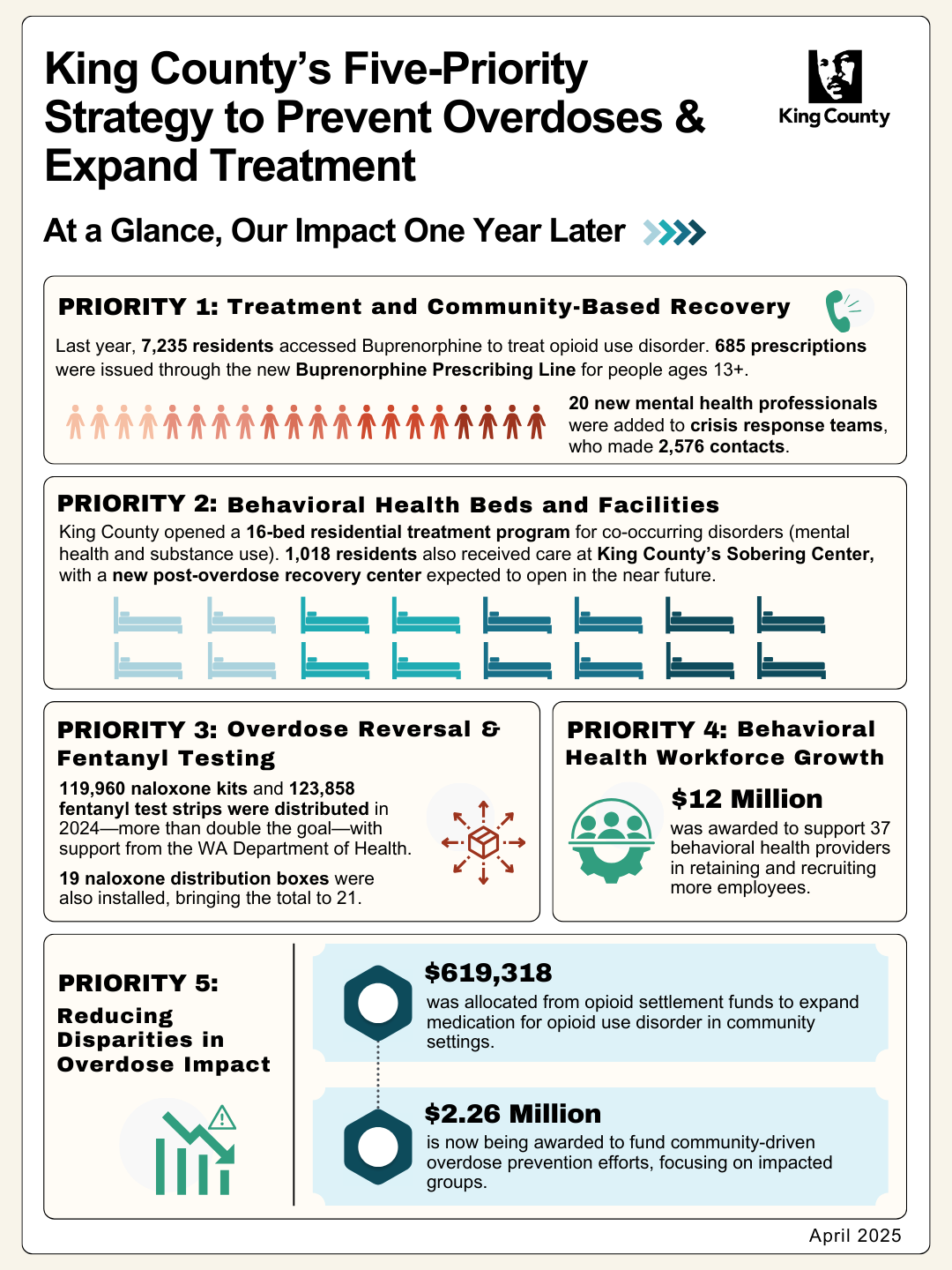
Around this time last year, King County announced a multi-part strategy to address the surge of fentanyl and overdoses. Guided by five priorities, the strategy expanded behavioral health treatment, increased access to medications for opioid use disorder, and made overdose prevention tools and resources more widely available. Today, we remain committed to continuing to advance solutions that work for our community.
Below is an update on each of King County’s five priorities and their impact.
Priority 1: Treatment and community-based, recovery-focused care for all
- In 2024, King County’s new Buprenorphine Prescribing Line issued 685 prescriptions for buprenorphine, a low-barrier medication for opioid use disorder.
- King County expanded the number of mobile teams that help people experiencing a mental health, drug, or alcohol crisis, with 33 teams traveling across the county to de-escalate crises and connect people to services (27 for adults and six for youth).
“Historically, starting treatment included jumping through all these hoops,” said Dr. Lauren Whiteside, a UW emergency physician who helped conceive the hotline and is one of 15 providers who answer the phone. “This program harnesses that exact moment [when someone is ready to start treatment] with a lot of support … so starting treatment doesn’t feel like this insurmountable task.” Read more: Need anti-withdrawal meds? In King County, call this 24/7 hotline | Urban@UW
“We’re here and we’re in lieu of a police officer,” said Joe Vela, Crisis Services Director at SOUND. “We’re better equipped, both clinically, and making connections with our peers, to deal with someone in crisis in the community.” Read more: King County deploys new mobile crisis teams to assist with mental health emergencies – KIRO 7 News Seattle
Priority 2: Behavioral health beds and facilities
- In partnership with Pioneer Human Services, King County opened a 16-bed residential treatment program in Seattle for people with co-occurring disorders (mental health and substance use).
- King County announced a permanent location for the Sobering Center in SODO, which it will aim to open by the end of 2025. The Sobering Center is currently operating in the Yesler Building and served 1,018 people in 2024.
- Together with the Downtown Emergency Service Center (DESC), the University of Washington (UW) and the City of Seattle, King County plans to open a post-overdose recovery center in the near future that provides medical follow-up and behavioral health treatment following an opioid overdose, which will add additional capacity and expand hours of operation to 24/7.
“This new sobering center is critical to King County’s ongoing work to connect more people to treatment, lifesaving interventions, and a path to recovery,” said King County Executive Shannon Braddock. “Together, with community members, partners, and regional leaders, we are expanding access to substance use disorder treatment and creating a safe place for people to go for support when they need it.”
Priority 3: Overdose reversal and fentanyl testing.
- In 2024, King County distributed 119,960 naloxone kits and 123,858 fentanyl test strips, more than double the original goal, in conjunction with Washington State Department of Health.
- 2,600 naloxone kits were dispensed from harm reduction vending machines in 2024 after King County Public Health added three vending machines at Compass Day Center, YouthCare Orion Center and the Maleng Regional Justice Center.
- To reduce accidental drug poisonings, Public Health – Seattle & King County expanded mobile drug checking services and added technician hours, allowing us to test more than 1,140 drug samples just last year.
“Our teams have been trained in compassionate overdose care recovery, acknowledging that all people are more receptive to care and services if they are met with respect and dignity. [After an overdose response] our mobile integrated health team was able to follow up the next day and connect the community members to substance use disorder care and provide the family with training on how to use naloxone and recognize overdose.” – Redmond Fire Department, Advanced Life Support (ALS)
Priority 4: A robust, diverse behavioral health workforce.
- King County awarded $12 million to support 37 behavioral health providers in retaining and recruiting more employees.
- An additional $4.8 million was also awarded to expand the SEIU Training Fund’s apprenticeship program.
Priority 5: Reduced disproportionality in overdoses.
- From opioid settlement funds, King County awarded $619,318 to support expanding access to Medications for Opioid Use Disorder in community-based settings.
- Public Health – Seattle & King County is awarding $2,267,642 to support community-centered overdose prevention and response efforts. Grant recipients will serve communities disproportionately impacted by opioid overdose.